
Blog / Honda Warning Lights

What Your Honda Warning Lights Mean and Why They Matter

A dashboard displaying a speedometer alongside a clock, used for tracking speed and time metrics.

Your Honda is designed to communicate with you. So when something needs attention and a warning light illuminates on your dashboard, it’s not scare you—it’s to protect you and your vehicle. Understanding what your Honda warning lights mean can help you make smarter decisions about when to keep driving around Columbia, Missouri, and when to schedule a service appointment. Ignoring these lights can sometimes turn a minor issue into a more costly repair down the road.


What Your Honda Warning Lights Indicate Under the Hood


Some of the most important warning lights relate to your engine and powertrain. The dreaded “check engine” light, which typically looks like an engine outline, can signal anything from a loose gas cap to a more serious emissions or sensor issue. The oil pressure warning light means your engine may not be getting adequate lubrication—if this one comes on, it is best to pull over safely and turn off the engine as soon as possible. The temperature warning light indicates your engine may be overheating, which requires immediate attention.


Electrical and Battery Warning Lights


The battery warning light means your vehicle's charging system isn’t functioning properly. It might come accompanied by symptoms like dimming headlights, sluggish engine turnover, and spotty infotainment system response. This could point to a failing alternator, a worn battery, or a loose connection. If this light stays on while you’re driving, your vehicle may lose power before you reach your destination, so get your system checked promptly to avoid being left stranded.


Safety System Warning Lights


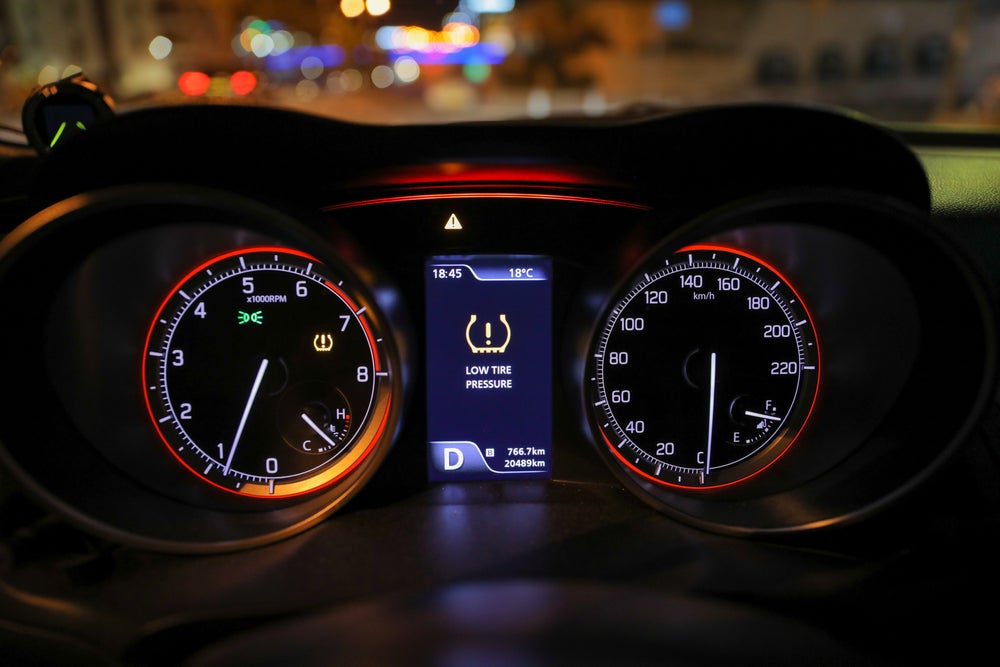
Modern Honda vehicles are equipped with a range of safety technologies, and several warning lights are tied to those systems. The brake warning light can indicate low brake fluid or that the parking brake hasn’t been fully released. The tire pressure monitoring system (TPMS) light means one or more of your tires may be underinflated, which can serious affect handling and safety. Underinflated tires can lead to a blowout, accelerate tire wear, and even reduce fuel economy—because your vehicle has to work harder for every mile. 

Honda Sensing® warning lights may also appear if sensors related to the Collision Mitigation Braking System™, Lane Keeping Assist, or Adaptive Cruise Control need attention or are temporarily obstructed. It may just mean you’ve turned those systems off, but if one goes, there’s likely more issues to come. These driver assistance technologies are meant to work as a team—and it’s only as strong as its weakest member. 


Honda Hybrid and Electric System Warnings


If you drive a Honda hybrid or electric model, you may also see warning lights specific to the high-voltage battery or electric motor systems. These lights should never be ignored, as they can indicate issues with components that are central to how your vehicle operates, such as the regenerative braking system that directly affects your fuel economy, the red battery light that signals your vehicle isn’t charging, or a Hybrid System light that indicates a fault in the battery pack or electric motor management. Refer to your owner's manual for specific guidance, and visit a qualified Honda service center if any powertrain-related warning light appears.


What to Do When a Warning Light Comes On


The most important thing to remember is that not all warning lights require the same level of urgency. A red light generally signals something that needs immediate action, while a yellow or amber light is usually a prompt to schedule service soon. A green light is just to tell you a system is active and working. When in doubt, check your owner's manual or contact a service advisor who can help you understand what your Honda warning lights indicate and what steps to take next.


Visit Columbia Honda for Expert Service


Drivers in Columbia, Missouri, can count on experienced Honda service professionals at Columbia Honda to diagnose warning lights accurately and get to the root of any issue. Whether it is a quick reset or a more in-depth repair, having trained technicians look at your vehicle ensures you are back on the road with confidence. Don’t wait until a small warning becomes a larger problem—schedule a service visit at columbiahonda.com and let the team help you keep your Honda running at its best.
Posted in:

Related Posts

Honda Warning Lights

Honda Warning Lights

Honda Warning Lights: The Dashboard Is Talking. Best Listen. A warning light appearing halfway through a journey has a remarkable ability to command your attention. But a Honda dashboard isn't simply a collection of illuminated reasons to panic. Those lights are there to report what the car's systems are seeing, and the color often gives you the first clue about what comes next. Some indicators simply confirm that a system is operating. Others are asking you to arrange an inspection soon in Columbia. A few are telling you to stop. Knowing which is which can prevent a minor warning from becoming a considerably larger repair. Start With the Color, Because Honda Does Dashboard warnings broadly follow a color-coded hierarchy. Green and blue indicators are generally informational, showing that a function or system is active. Yellow or amber deserves more attention: the vehicle has detected something that should be checked, although it doesn't automatically mean you need to stop immediately. Red is different. A red warning can indicate a serious problem requiring immediate attention. That's important, because continuing to drive with certain red warnings—particularly those involving oil pressure, engine temperature, or the braking system—can risk mechanical damage or compromise the vehicle's operation. Four Lights You're Particularly Likely to Meet The check engine light is perhaps the most familiar and certainly one of the broadest in meaning. Its cause can range from something as simple as a loose gas cap to a more involved engine problem, which is why diagnosis is important instead of assumption. The red oil pressure warning deserves a much faster response: safely pull over and switch off the engine as soon as possible, because insufficient oil pressure can result in serious engine damage. The battery warning points toward the vehicle's electrical or charging system and warrants inspection. Then there's the Tire Pressure Monitoring System warning, represented by a tire-shaped symbol containing an exclamation point. It indicates that one or more tires may be underinflated, something particularly worth checking when outside temperatures have changed. Some Warnings Mean Book Service. Others Mean Stop. The crucial skill isn't memorizing every dashboard symbol; it's understanding the difference between a warning you can investigate soon and one requiring immediate action. A yellow tire-pressure or maintenance warning will generally allow time to arrange a service appointment. A red oil-pressure, engine-temperature, or brake-system warning deserves a different response. If a red warning appears alongside unusual noises or a noticeable change in the way the Honda drives or handles, find somewhere safe to stop and contact a service professional. Continuing in the hope that the light disappears is not diagnosis, and it can turn an identifiable fault into a more expensive one. Your Owner's Manual Knows Your Dashboard Best Honda models and trims can have different indicators, so the owner's manual remains one of the best references for identifying precisely what has appeared in front of you. It contains dashboard information specific to the vehicle rather than a generic list assembled for every Honda ever built. Honda's MyGarage platform can also provide access to manuals, warranty information, and other ownership resources. If the warning still isn't clear, don't diagnose it by symbol alone. A qualified technician can perform a diagnostic check, read relevant fault codes, inspect the affected system, and determine why the warning appeared in the first place. Don't Let a Small Light Become a Big Repair Warning lights work best when they're treated as information requiring the appropriate response, not merely irritating decorations on the instrument panel. Check the owner's manual when an unfamiliar indicator appears, pay particular attention to red warnings, and have persistent or unexplained alerts inspected instead of waiting for them to disappear. Drivers around Columbia, MO, can bring their Honda to the Columbia Honda service center for diagnostic testing and professional inspection. If a warning light has appeared or your Honda is behaving differently than normal, schedule a service appointment and let the technicians determine what the dashboard has been trying to tell you.

2026 Honda Ridgeline

2026 Honda Ridgeline

2026 Honda Ridgeline: A Midsize Truck That Does Things Differently The 2026 Honda Ridgeline has never followed the traditional midsize-truck formula, and that's exactly where its appeal begins. Every model gets a 280 hp V6, i-VTM4® AWD, a 9-speed automatic transmission, and up to 5,000 lbs. of towing capacity, but the more interesting engineering is found in its independent suspension and unusually versatile cargo system. For drivers around Columbia, MO, the Ridgeline combines seating for 5 with legitimate hauling hardware and several bed features conventional pickups simply don't offer. The V6 and AWD Are Standard Equipment Every 2026 Ridgeline uses a direct-injected 3.5L i-VTEC® V6 producing 280 hp and 262 lbs. ft. of torque, paired with a 9-speed automatic transmission and standard i-VTM4® AWD. Intelligent Traction Management adds Normal, Snow, Sand, and Mud modes, giving drivers settings tailored to changing surfaces without requiring a separate drivetrain configuration. The Ridgeline also uses a fully independent MacPherson-strut front and multi-link rear suspension, a significant mechanical departure from many traditional pickups. Every trim can tow up to 5,000 lbs., while Sport provides a maximum payload capacity of 1,583 lbs., giving the truck enough capacity for trailers, equipment, and weekend projects. The Bed Is Where the Ridgeline Gets Clever Honda's composite bed provides 33.9 cubic feet of cargo volume and measures 64 inches long with the tailgate raised, with 50 inches of width between the wheel wells. Beneath the floor sits one of the Ridgeline's defining features: a lockable 7.3-cubic-foot In-Bed Trunk® with a drain plug. It creates enclosed storage without occupying cabin space or requiring a separate toolbox above the bed. The Dual-Action Tailgate can drop conventionally or swing open from the side, making access to the In-Bed Trunk® considerably easier, while an available 150W/400W truck-bed power outlet can supply electricity to compatible equipment. Five Adults Get a Proper Cabin Every Ridgeline seats 5, with 40.9 inches of front legroom and 36.7 inches in the second row. A 60/40 split lift-up rear seat exposes 2.9 cubic feet of underseat storage, giving owners another place to secure smaller equipment inside the cab, while tri-zone automatic climate control is standard. RTL adds perforated leather-trimmed seating, heated front seats, a 10-way power driver's seat, one-touch power moonroof, and power sliding rear window. Black Edition moves further with ventilated front seats, heated rear outboard seats, and a heated steering wheel. The Standard Technology Covers the Important Stuff A 9-inch touchscreen, 7-inch digital meter display, wireless Apple CarPlay® and Android Auto™, HondaLink®, and wireless phone charging come standard across the 2026 Ridgeline lineup. Sport, RTL, and TrailSport use a 215-watt 7-speaker audio system, while Black Edition upgrades to a 540-watt 8-speaker setup. Honda Sensing® driver-assistance technology is also standard, giving buyers the core safety and connectivity equipment without requiring a move into one of the higher configurations. TrailSport Adds Hardware for Leaving the Pavement TrailSport builds from RTL but changes more than wheels and exterior trim. Honda adds an off-road-tuned suspension, 18-inch Shark Gray alloy wheels with P245/60 R18 all-terrain tires, and an oil-pan skid plate, giving this version hardware designed for rougher surfaces. Front and rear parking sensors, Honda Satellite-Linked Navigation System™, a heated steering wheel, Trail Orange stitching, orange ambient lighting, and all-weather floor mats are also included. TrailSport+ adds 18-inch Honda Performance Development™ black alloy wheels for buyers looking for a different wheel treatment without changing the underlying TrailSport equipment. Four Core Trims Cover Different Jobs Sport establishes the Ridgeline's mechanical foundation with the V6, AWD, 5,000-lb. towing capability, and core cabin technology already in place. RTL adds leather and comfort equipment, TrailSport introduces its off-road suspension, all-terrain tires, and skid plate, and Black Edition concentrates on premium cabin features with distinctive 18-inch Berlina Black wheels. Available TrailSport+ HPD wheel and Black Edition Two-Tone configurations provide additional appearance choices while retaining the capability of their respective core trims. Put the 2026 Ridgeline to Work at Columbia Honda Drivers around Columbia, MO, can visit Columbia Honda to compare Ridgeline trims, explore available Honda truck inventory, and see how features such as the In-Bed Trunk®, Dual-Action Tailgate, and TrailSport hardware work in person. Schedule a test drive online to experience the 280 hp V6, standard i-VTM4® AWD, and independent suspension from the driver's seat.

2027 Honda HR-V

2027 Honda HR-V

2027 Honda HR-V: Honda Keeps Its Small Crossover Simple There’s something almost refreshing about a car range that doesn’t require a spreadsheet to understand it. The 2027 Honda HR-V comes in 3 trims—LX, Sport, and EX-L—and all share the same engine, transmission, basic dimensions, and 5-seat layout. What changes is the equipment, not the fundamental character of the car. For drivers around Columbia, MO, there’s a 158-hp engine, as much as 55.1 cubic feet of cargo capacity, and the option of Real Time AWD™ from the bottom of the range to the top. No Engine Hierarchy Here Every HR-V uses Honda’s naturally aspirated 2.0L 4-cylinder engine, producing 158 hp and 138 lbs. ft. of torque through a continuously variable transmission. FWD is standard, while Real Time AWD™ with Intelligent Control System™ is available on LX, Sport, and EX-L. Econ, Normal, and Snow drive modes are standard, along with Hill Descent Control, and the chassis combines MacPherson struts at the front with a multi-link rear suspension. EPA fuel-economy ratings are 26 mpg city, 32 mpg highway, and 28 mpg combined with front-wheel drive. AWD models return 25 mpg city, 30 mpg highway, and 27 mpg combined. In other words, choosing AWD costs 1 mpg on the combined figure. Three Trims, Three Different Priorities The LX isn’t painfully basic. It comes with 17-inch Pewter Gray alloy wheels, LED headlights, automatic climate control, a 9-inch touchscreen, wireless Apple CarPlay® and Android Auto™ compatibility, and wireless phone charging. Sport changes the appearance with 18-inch Gloss Black alloys, a Sport grille, gloss-black detailing, heated side mirrors, and a chrome exhaust finisher, while heated front seats, a leather-wrapped steering wheel and shift knob, remote engine start, Smart Entry with Walk Away Auto Lock®, and a 6-speaker 180-watt audio system add substance. EX-L concentrates on comfort, adding leather-trimmed seats, an 8-way power driver’s seat, dual-zone automatic climate control, an 8-speaker 180-watt audio system, a one-touch power moonroof, and 18-inch machine-finished wheels with Berlina Black inserts. Small Outside Doesn't Mean Cramped Inside At 179.8 inches long on a 104.5-inch wheelbase, the HR-V remains compact enough to justify the description, yet the cabin numbers are respectable. There’s 41.9 inches of front legroom and 37.7 inches in the second row, so rear passengers haven’t been sacrificed in pursuit of a tidy exterior footprint. Cargo capacity is 24.4 cubic feet with the second row upright and 55.1 cubic feet after folding the 60/40-split rear seat. LX and Sport provide 98.7 cubic feet of passenger volume, while EX-L drops slightly to 97.3 cubic feet, due in part to its standard moonroof. The Safety Equipment Doesn't Start Halfway Up the Range Honda Sensing® is standard on every 2027 HR-V. It includes the Collision Mitigation Braking System™, Road Departure Mitigation System, Adaptive Cruise Control with Low-Speed Follow, Lane Keeping Assist System, Traffic Sign Recognition, Traffic Jam Assist, and Driver Attention Monitor. Moving to Sport or EX-L adds the Blind Spot Information System with Cross Traffic Monitor. EX-L adds Low-Speed Braking Control plus 4 front and 4 rear parking sensors. It’s a straightforward equipment progression: the core driver-assistance systems arrive on LX, with additional low-speed and surrounding-traffic assistance appearing farther up the range. Choose the Equipment, Then Consider AWD For Columbia drivers, selecting a 2027 Honda HR-V comes down largely to equipment and traction rather than mechanical performance. LX establishes a strong technology baseline, Sport adds heating, convenience features, and visual changes, while EX-L brings leather, more cabin equipment, and additional driver assistance. Drivers can explore the new Honda inventory at Columbia Honda, compare LX, Sport, and EX-L configurations, or schedule a test drive online today to decide which version suits the way they drive.